Assalamu aleikum
In the book entitled: "Tajweed Rules of the Qur'an part 2" on page 23 (Letters that are lightened sometimes and are made heavy other times) it is written that:
" The alif is not characterized as having tafkheem or tarqeeq, but instead it is known to follow the letter preceding it as to tafkheem or tarqeeq. If a tafkheem letter precedes it then it also has tafkheem...".
My question is: Does this rule apply also to the other light letters such as "baa" and "miim"? For example the word "Al-BaSiir" (Surah 42 verse 11) and "Al-MaSiir" (Surah 40 verse 3). The "baa" in "Al-BaSiir" is light but is followed by the "Saad" which is a heavy letter; the same with the "miim" in "Al-MaSiir". Therefore should the "baa" and "miim" be pronounced light or heavy?
Jazakumulahi khairan
Wa salamu aleikum wa rahmatulilahi wa barakatuh
Answer
Wa alaikum assalaam wa rahmatullahi wa barakatuh,
Only the alif has this characteristic of following the letter before it as to tafkheem and tarqeeq, the other letters keep their own characteristics.
Actually, one has to be careful about not making tafkheem of a letter of tarqeeq which precedes a letter of tafkheem. The examples given in the question are perfect examples of letters we need to be cautious in reading, so not to make tafkheem. The  in
in 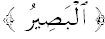 and
and  in
in 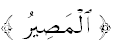 should have tarqeeq, and should not be influenced by the
  that follows these letters.
Imam Ibn Al-Jazaree warned us to be careful not to make tafkheem of letters that have the characteristic of  in the following lines of poetry:
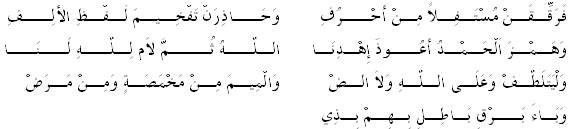
So make tarqeeq of letters of istifaal
and be careful [not to] make tafkheem of the utterance of the alif
and hamzah in al-hamdu, a’oodhu ihdinaa
Allahu then the laam of lillahi lanaa
[and in] 
[meaning do not make tafkeem of the laam in these words/phrases including the alif in  before the Glorious name of that is pronounced with tafkheem, as well as the
  in
in  ]
]
And the meem of  and
and 
[do not make tafkheem of the meem in these words]
And the ba’ of  and
and 
[do not make tafkheem of the ba’ in these words].
We can see then, that we have to take care not to make tafkheem on letters when they are preceded or followed by a letter of tafkheem.
Wa iyyaakum. Wa alaikum assalaam wa rahmatullahi wa barakatuh.